
- Why Core Entity Design Comes First
- Organizations: The Root Context
- Systems: Defining the Operational Boundary
- Users and Contacts: The Accountability Layer
- Establishing the Root Hierarchy
- Why This Matters in Formidable Forms
- Designing for Reuse, Not Convenience
- The Architectural Principle Behind Everything
- Closing Thought
Every enterprise application eventually reveals what it is truly built around.
Not the interface.
Not the workflows.
Not even the reporting layer.
The underlying truth of any system is found in its entities.
If the entities are poorly defined, the application becomes unstable no matter how polished the front end appears. Reporting becomes inconsistent. Relationships become fragile. Data duplication spreads quietly through the system until every enhancement introduces unintended consequences.
This is where many WordPress projects fail long before anyone notices.
The forms may work perfectly.
The architecture does not.
That is why this article matters.
In the previous article, we established the importance of relational modeling in Formidable Forms. Now we move into the first concrete implementation layer: defining the foundational entities that anchor the entire governance platform.
For this system, those entities are:
- Organizations
- Systems
- Users / Contacts
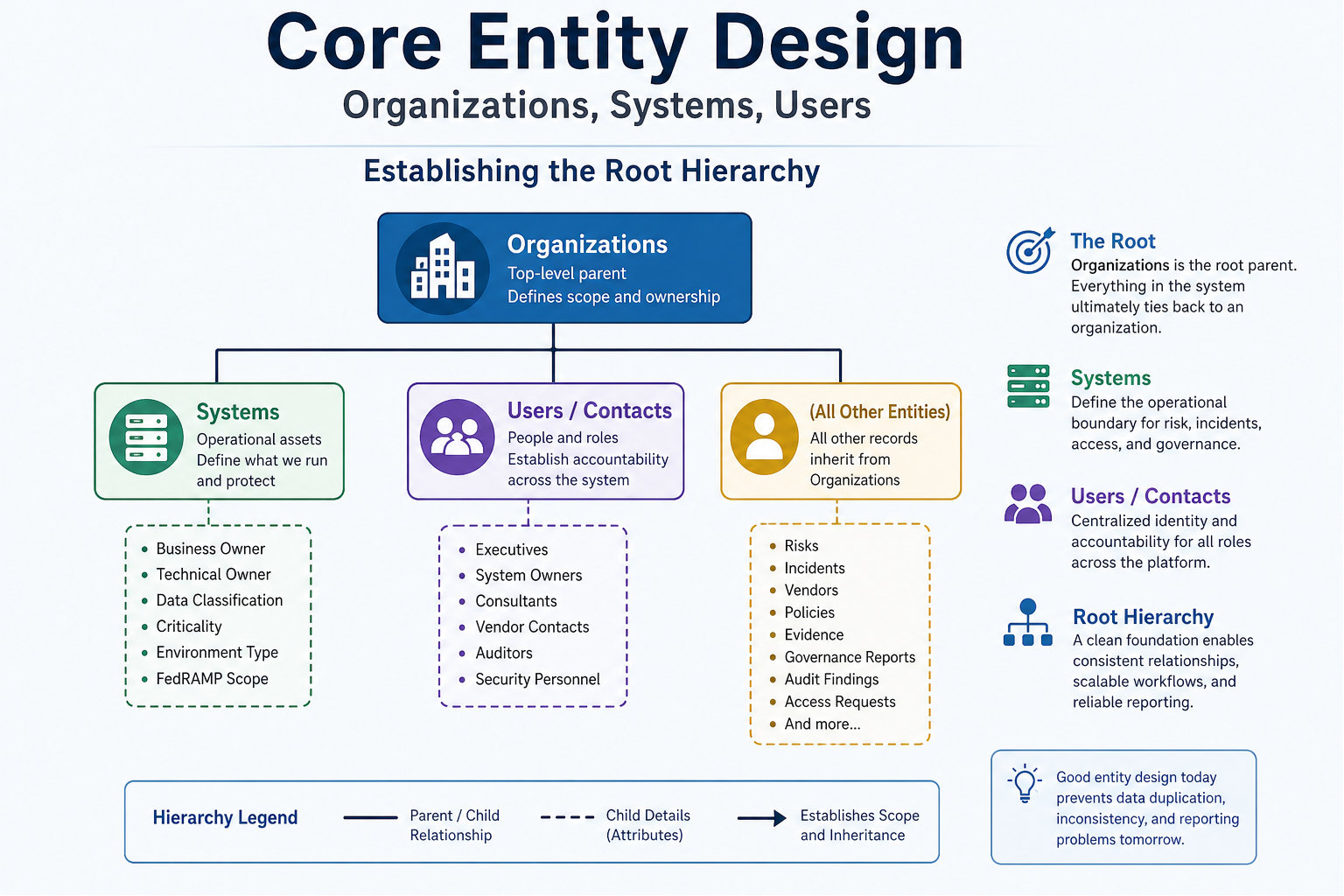
These are not just records. They are the root hierarchy from which nearly everything else inherits meaning.
Why Core Entity Design Comes First
One of the most common mistakes in application development is beginning with workflows instead of entities.
Developers often start by asking:
“What form do we need first?”
The better question is:
“What objects exist in the system?”
That distinction changes everything.
Forms are interfaces.
Entities are architecture.
The implementation blueprint for this project defines Organizations as the root parent for almost all records, with Users Contacts and Systems Assets serving as foundational reference entities throughout the application.
That structure is intentional.
Before risks can exist, systems must exist.
Before incidents can exist, organizations must exist.
Before approvals and decisions can exist, users must exist.
The hierarchy has to be established before the workflows built on top of it can behave predictably.
Organizations: The Root Context
The Organization entity is the top-level anchor of the entire governance platform.
Every major operational domain references it:
- Systems
- Risks
- Incidents
- Vendors
- Evidence
- Governance Reports
- Policies
- Access Requests
- Audit Findings
This gives the system a consistent scope boundary.
Without a root organization model, filtering becomes chaotic. Multi-client support becomes unreliable. Dashboard segmentation becomes difficult. Reporting logic becomes repetitive and fragile.
With it, everything inherits a shared context.
The Organization form itself is intentionally simple:
- Organization Record ID
- Organization Name
- Industry / Sector
- FedRAMP Scope Status
- Executive Sponsor
- Consultant
- Active Status
That simplicity is important.
Core entities should define identity and ownership—not absorb every imaginable attribute simply because someone discovered another field type and became emotionally attached to it.
A clean root entity creates long-term flexibility.
Systems: Defining the Operational Boundary
If Organizations define ownership, Systems define operational reality.
This is where the governance platform begins mapping risk, access, incidents, and oversight to actual technology assets.
The Systems Assets entity acts as the control boundary for much of the application. Risks reference systems. Access requests reference systems. Incidents reference systems. Vendor relationships often connect back to systems.
This is critical because governance without asset context becomes abstract very quickly.
You cannot meaningfully answer:
- “What is affected?”
- “What is in scope?”
- “Who owns this?”
- “What data classification applies?”
…without a stable systems inventory.
The Systems entity includes:
- Business Owner
- Technical Owner
- Data Classification
- Criticality
- Environment Type
- FedRAMP Scope Indicator
Notice what this structure accomplishes.
The system is no longer storing “servers” or “applications” as loose labels typed into random forms. It is creating reusable, referenceable records that every governance process can inherit consistently.
This is one of the defining characteristics of enterprise architecture:
You stop storing names.
You start referencing entities.
Users and Contacts: The Accountability Layer
In governance systems, accountability matters as much as data.
That accountability layer is established through the Users Contacts entity.
This form stores:
- Executives
- System owners
- Consultants
- Vendor contacts
- Auditors
- Security personnel
Almost every workflow in the application references this entity in some way:
- Risk owners
- Reviewers
- Approvers
- Incident leads
- Decision owners
- Vendor contacts
- Governance report preparers
This creates a centralized identity model for the platform.
Without it, systems typically devolve into duplicated text fields:
- “Owner Name”
- “Reviewer”
- “Manager”
- “Approver”
…and eventually:
- “Final Approver 2”
- “Backup Reviewer”
- “Steve From Accounting (Temporary)”
That path leads to inconsistency, stale data, and reporting pain.
Centralized contact entities solve this by turning people into reusable relational references.
Update the contact once.
The entire application inherits the update.
That is exactly how enterprise systems are supposed to behave.
Establishing the Root Hierarchy
At this stage, the system hierarchy becomes clear.
The root looks like this:
Organization
├── Systems
├── Contacts
├── Vendors
├── Policies
├── Governance Reports
├── Risks
├── Incidents
└── Evidence
Then secondary parent-child relationships branch downward:
Risk
├── Risk Reviews
└── Risk Acceptances
Incident
└── Incident Decisions
Audit Finding
└── Remediation Actions
This hierarchy is what allows the application to maintain relational coherence across the entire governance lifecycle.
Without it, the system becomes a collection of disconnected records.
With it, every entity participates in a structured operational narrative.
Why This Matters in Formidable Forms
This is the point where Formidable Forms starts behaving less like a plugin and more like an application framework.
The moment entities become reusable relational objects:
- Dynamic Lookups become foreign-key references
- Views become reporting interfaces
- Child forms become lifecycle histories
- Conditional logic becomes workflow enforcement
- Dashboards become operational control surfaces
Nothing about Formidable itself changed.
The architecture did.
That distinction is important because many developers underestimate what Formidable can do—not because the tool lacks capability, but because the data model was never designed to support enterprise behavior in the first place.
Designing for Reuse, Not Convenience
A common anti-pattern in WordPress development is designing around immediate convenience instead of long-term maintainability.
For example:
Instead of referencing a System entity, developers type the system name directly into a risk form.
It feels faster initially.
Until:
- the system name changes,
- reporting becomes inconsistent,
- filtering breaks,
- duplicate entries appear,
- and executives start asking why “CRM,” “CRM Platform,” and “Customer Relationship Management System” appear as three separate assets in the dashboard.
Entity-driven architecture prevents that class of problem.
The goal is not merely to collect information.
The goal is to create reusable, referenceable operational truth.
That is what allows systems to scale.
The Architectural Principle Behind Everything
The deeper lesson here is not about Organizations, Systems, or Contacts specifically.
It is about modeling reality explicitly.
Enterprise systems succeed when:
- ownership is clear,
- relationships are structured,
- accountability is traceable,
- and references are reusable.
That is the foundation we are building in this series.
Everything else—risks, incidents, governance reporting, evidence generation—depends on these core entities behaving correctly.
If the foundation is weak, every downstream workflow inherits the weakness.
If the foundation is strong, the system becomes extensible almost automatically.
That is not accidental.
That is architecture.
Closing Thought
Most WordPress projects are built from the screen outward.
Enterprise systems are built from the data model outward.
That is the transition happening in this series.
Organizations establish scope.
Systems establish operational context.
Users establish accountability.
Together, they form the root hierarchy that the entire governance platform depends upon.
Next week, we move into domain modeling—where risks, incidents, access governance, and audit workflows begin attaching themselves to the architectural foundation we have now established.

Leave a Reply