

Every application appears scalable at small scale. A few forms.A few hundred entries.Minimal relationships.Simple Views. At that stage, almost every architectural decision feels acceptable. Enterprise systems expose reality. As governance platforms mature, they begin accumulating: Eventually, performance stops being theoretical. Views slow down.Queries multiply.Dashboard latency increases.Exports become expensive.Administrators begin saying:“It was fast when we launched.” [Read More…]
Export & Packaging — Structuring Governance Outputs for Auditors and Assessors

At this stage in the series, the governance platform is functionally complete. We now have: But enterprise governance systems are ultimately evaluated in moments of scrutiny. An audit begins.An assessor requests documentation.An insurer demands evidence.A regulator asks questions.A board requests a readiness package. This is where many systems break down. Not because the organization lacks [Read More…]
Views as Application Interfaces — Transforming Governance Data into Decision Systems

Up to this point in the series, we have focused heavily on architecture beneath the surface. We built: Those layers define how the system stores, governs, and preserves information. But enterprise applications ultimately succeed or fail based on something more visible: How people interact with the data. This is where Views become critically important. In [Read More…]
Evidence Abstraction — Turning Governance Records into Reusable Evidence

At this point in the series, the platform has become structurally mature. We have: But enterprise governance systems are ultimately judged by one capability above all others: Can they produce defensible evidence quickly and consistently? This is where the Evidence Abstraction Layer enters the architecture. Without it, organizations are forced to reconstruct evidence manually every [Read More…]
The Decision & Traceability Layer — Preserving Accountability Over Time
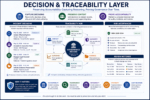
Up to this point in the series, we have focused heavily on structure. We established: Those layers define how the system operates. But enterprise governance requires something more difficult: Historical accountability. Not just:“What is the current state?” But: That is the purpose of the decision and traceability layer. This is where the platform stops functioning [Read More…]
Workflow & State Management — Turning Forms into Governed Processes
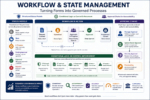
At this stage in the series, the architecture is no longer theoretical. We now have: But something critical is still missing. Behavior. A system is not governed simply because it stores records. Governance emerges from: This is where workflow and state management enter the architecture. Without them, a form is just storage. With them, the [Read More…]
Domain Modeling — Mapping Governance Domains into Forms
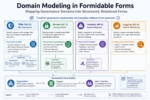
By this point in the series, the foundation is in place. We have established: Now the system becomes operational. This is where abstract architecture meets real governance. We move from what exists to what happens. That transition is handled through domain modeling. What Domain Modeling Actually Means In enterprise systems, domains represent functional areas of responsibility. In this [Read More…]
Core Entity Design — Organizations, Systems, and Users
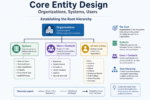
Every enterprise application eventually reveals what it is truly built around. Not the interface.Not the workflows.Not even the reporting layer. The underlying truth of any system is found in its entities. If the entities are poorly defined, the application becomes unstable no matter how polished the front end appears. Reporting becomes inconsistent. Relationships become fragile. [Read More…]