
Up to this point in the series, we have focused heavily on architecture beneath the surface.
We built:
- relational structures,
- governance domains,
- workflow enforcement,
- traceability,
- and evidence abstraction.
Those layers define how the system stores, governs, and preserves information.
But enterprise applications ultimately succeed or fail based on something more visible:
How people interact with the data.
This is where Views become critically important.
In many Formidable projects, Views are treated primarily as:
- reporting tools,
- list displays,
- or front-end formatting utilities.
That perspective dramatically understates their architectural role.
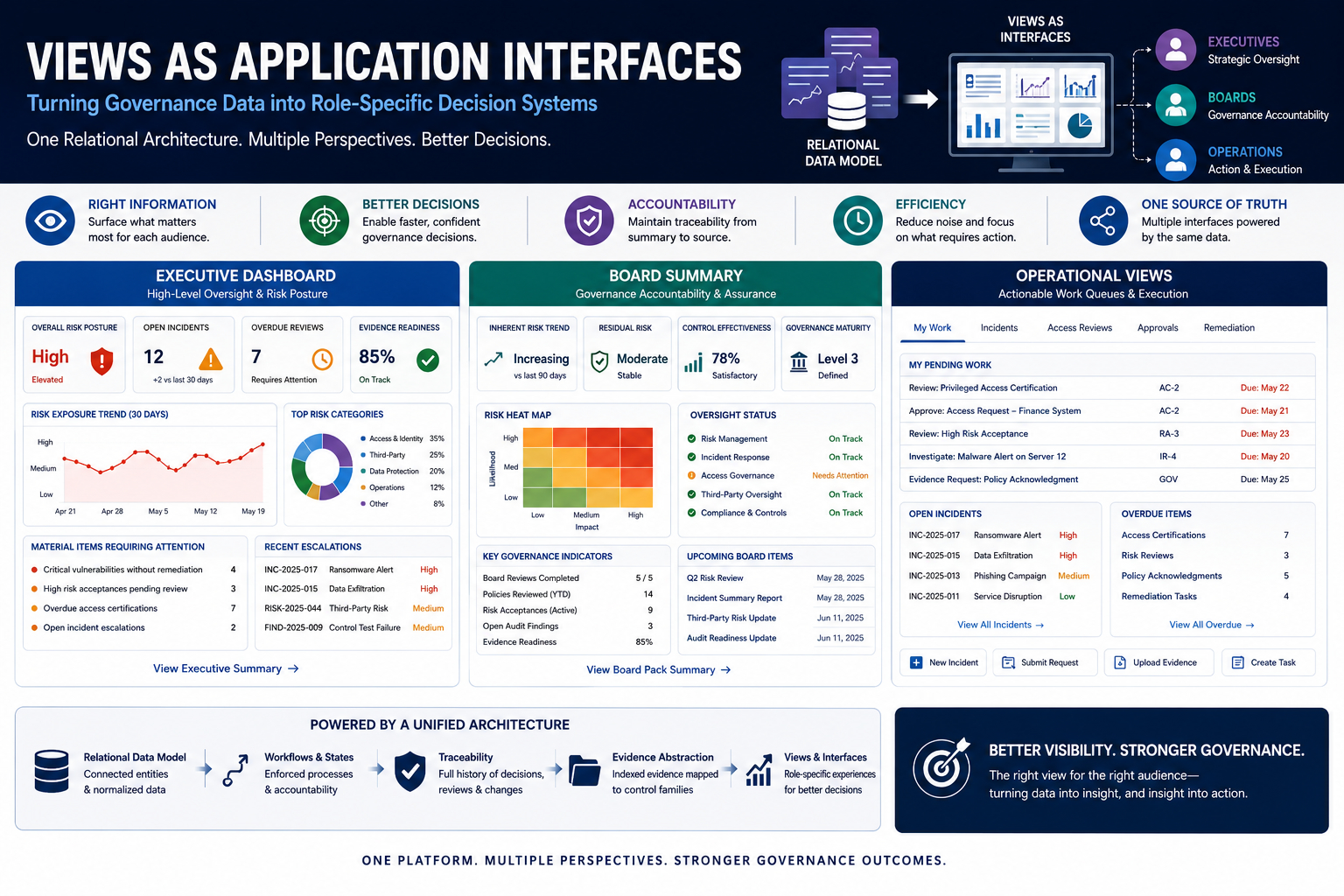
In enterprise systems, Views are not merely presentation layers.
They are application interfaces.
They define:
- what leadership sees,
- what operators act upon,
- what boards evaluate,
- and what assessors interpret as evidence of governance maturity.
That makes Views one of the most strategically important layers in the entire platform.
- Why Interfaces Matter in Governance Systems
- The Architectural Shift: Views as Functional Interfaces
- Executive Dashboards: Translating Operations into Oversight
- Board Summaries: Strategic Abstraction Without Losing Integrity
- Operational Views: Enabling Action
- Role-Based Visibility and Governance Integrity
- Views as Decision Interfaces
- The Importance of Contextual Data
- Views as an Alternative to Traditional Applications
- Common View Design Failures
- The Emerging Architectural Pattern
- Closing Thought
Why Interfaces Matter in Governance Systems
Most governance failures are not caused by missing data.
They are caused by:
- invisible risk,
- fragmented visibility,
- unclear accountability,
- or delayed understanding.
Organizations often possess the information they need.
The problem is that the information is:
- scattered,
- overwhelming,
- poorly contextualized,
- or surfaced to the wrong audience.
A board does not need raw incident records.
An analyst does not need executive summaries.
An assessor does not need decorative dashboards.
An operator does not need strategic abstractions.
Each role requires:
- a different lens,
- a different level of detail,
- and a different interface model.
This is where Views become much more than reporting screens.
They become role-specific governance surfaces.
The Architectural Shift: Views as Functional Interfaces
The deeper architectural shift is this:
A View is not simply displaying data.
A View is exposing a curated operational perspective of the system.
That means every View implicitly answers:
- What matters to this audience?
- What actions should be visible?
- What level of abstraction is appropriate?
- What decisions need support?
This distinction is critical.
Without intentional View design, systems often become:
- noisy,
- overwhelming,
- or operationally meaningless.
Good governance interfaces reduce ambiguity.
They elevate signal over noise.
Executive Dashboards: Translating Operations into Oversight
Executive dashboards are one of the most misunderstood interface types in governance systems.
Many dashboards fail because they optimize for:
- visual density,
- technical telemetry,
- or metric quantity.
Executives do not need operational exhaust.
They need decision-support visibility.
The platform’s executive Views should therefore focus on:
- current risk posture,
- open incidents,
- material escalations,
- unresolved findings,
- overdue reviews,
- and governance trends over time.
Not raw operational detail.
An effective executive dashboard answers questions like:
- Where are our highest risks?
- What is unresolved?
- What requires leadership attention?
- Which governance obligations are aging?
- Where are control failures emerging?
- What exposure is increasing?
That is governance visibility.
The underlying architecture we established earlier:
- relational entities,
- workflow states,
- review histories,
- and evidence mappings
now becomes actionable through Views.
This is where the system stops feeling like a database and starts functioning like a governance platform.
Board Summaries: Strategic Abstraction Without Losing Integrity
Board reporting requires a different level of abstraction entirely.
Boards govern exposure—not operations.
That means board Views should prioritize:
- trends,
- materiality,
- accountability,
- escalation patterns,
- and governance readiness.
Not ticket queues.
Not low-level operational metrics.
One of the most common mistakes in governance systems is surfacing operational detail directly to boards without abstraction or context.
That creates noise instead of clarity.
A proper board summary View should surface:
- material incident trends,
- unresolved high-risk items,
- risk acceptance exposure,
- governance review cadence,
- compliance posture,
- and evidence readiness indicators.
Importantly, these summaries should still maintain traceability back to underlying records.
This is one of the major architectural benefits of relational systems:
- abstraction without disconnection.
The board sees summarized governance posture.
The system still preserves drill-down accountability beneath it.
That balance is critical.
Operational Views: Enabling Action
Operational Views sit at the opposite end of the abstraction spectrum.
These interfaces are action-oriented.
Their purpose is not governance summarization.
Their purpose is workflow execution.
Operational Views typically include:
- open work queues,
- pending approvals,
- incident timelines,
- overdue reviews,
- provisioning tasks,
- remediation tracking,
- and escalation workflows.
These Views prioritize:
- clarity,
- urgency,
- ownership,
- and actionable state visibility.
For example:
An analyst View might surface:
- alerts requiring review,
- unresolved escalations,
- or pending evidence requests.
An access governance View might show:
- requests awaiting approval,
- privileged access reviews,
- or overdue recertifications.
An incident response View might display:
- severity,
- timeline progression,
- linked decisions,
- and affected systems.
This is where workflow architecture and interface architecture converge.
The View becomes the operational workspace.
Role-Based Visibility and Governance Integrity
One of the major advantages of Views in Formidable Forms is role-based visibility.
Different users can experience entirely different operational realities from the same relational data structure.
This matters enormously in governance systems.
For example:
- executives see summaries,
- operators see workflow queues,
- assessors see evidence packets,
- reviewers see pending certifications,
- and boards see oversight indicators.
All powered by:
- the same underlying records.
This creates something extremely valuable:
Single-source governance integrity.
Instead of maintaining separate systems for:
- operations,
- oversight,
- and reporting,
the platform produces multiple perspectives from one relational architecture.
That dramatically reduces inconsistency and reporting fragmentation.
Views as Decision Interfaces
This is where the architectural maturity of the platform becomes fully visible.
The system is no longer simply:
- collecting records,
- managing workflows,
- or storing evidence.
It is now:
- supporting decision-making directly.
Every dashboard, queue, summary, and escalation View becomes:
- a decision interface.
This is particularly important because governance is ultimately about:
- visibility,
- prioritization,
- and accountable judgment.
Poor interfaces obscure governance.
Strong interfaces operationalize it.
The Importance of Contextual Data
One of the reasons relational architecture matters so much is that Views become dramatically more powerful when context is preserved.
For example:
An incident dashboard is significantly more valuable when it can surface:
- linked systems,
- associated risks,
- related decisions,
- responsible owners,
- evidence status,
- and escalation history
within the same interface.
Without relational context, dashboards become shallow.
With relational context, dashboards become operationally intelligent.
This is another point where Formidable becomes much more capable than many developers initially realize.
Views as an Alternative to Traditional Applications
One of the deeper realizations developers eventually reach is this:
Many enterprise applications are fundamentally:
- relational data models
plus - interface layers.
That is precisely what Formidable Views can become when architected intentionally.
Instead of building:
- separate reporting portals,
- disconnected dashboards,
- or custom administrative interfaces,
Views can provide:
- operational workspaces,
- executive dashboards,
- board reporting layers,
- evidence review portals,
- and governance management interfaces
directly from the relational platform itself.
This dramatically accelerates application development.
More importantly, it preserves architectural consistency.
Common View Design Failures
Several anti-patterns undermine governance interfaces quickly.
1. Dashboard Overload
Too many metrics create paralysis rather than insight.
2. Lack of Audience Separation
Boards, operators, and executives should not consume identical interfaces.
3. Static Reporting
Governance systems should provide live operational visibility—not frozen snapshots whenever possible.
4. Missing Drill-Down Relationships
Summaries without traceability undermine accountability.
5. Decorative Dashboards
Visual complexity without governance relevance creates distraction rather than operational value.
The Emerging Architectural Pattern
At this stage in the series, the platform has evolved into a fully layered governance architecture:
Entities establish structure.
Domains establish operational scope.
Workflows enforce governance.
Traceability preserves accountability.
Evidence abstraction creates defensibility.
Views operationalize visibility.
This is the point where the application becomes genuinely interactive at an organizational level.
Not merely a database.
Not merely a workflow engine.
A decision-support platform.
Closing Thought
The value of enterprise systems is not determined solely by the data they store.
It is determined by whether the right people can see the right information at the right level of abstraction when decisions must be made.
That is the role of Views as application interfaces.
Executive dashboards transform governance activity into oversight visibility.
Board summaries transform operational complexity into strategic accountability.
Operational Views transform workflows into actionable systems of record.
Together, they convert relational governance architecture into something organizations can actually use to govern, prioritize, escalate, and decide.
Next week, we will move into Export & Packaging — where governance data, evidence mappings, and relational outputs become structured assessment packets, executive deliverables, and assessor-ready reporting artifacts.

Leave a Reply