
At this stage in the series, the architecture is no longer theoretical.
We now have:
- Relational data structures
- Core entities
- Governance domains mapped into forms
But something critical is still missing.
Behavior.
A system is not governed simply because it stores records.
Governance emerges from:
- how records move,
- how decisions are enforced,
- who is authorized to approve changes,
- and whether state transitions reflect actual operational control.
This is where workflow and state management enter the architecture.
Without them, a form is just storage.
With them, the application begins behaving like a controlled system.
- Why State Matters
- Status Models: Defining Operational Reality
- Workflow as a Controlled Sequence
- Conditional Logic as Control Enforcement
- Approval Chains: Modeling Authority
- State Management and Reporting
- Workflow Architecture in Formidable Forms
- The Emerging Pattern
- Common Workflow Design Mistakes
- Why This Matters Beyond Compliance
- Closing Thought
Why State Matters
Most enterprise workflows are not static.
Risks evolve.
Access requests progress through approvals.
Incidents escalate and recover.
Findings move toward remediation.
Each of these processes changes state over time.
That state progression is not cosmetic. It represents operational truth.
For example:
- An access request should not appear “Provisioned” before approvals exist.
- A risk should not appear “Accepted” without formal acceptance authority.
- An incident should not be marked “Closed” while escalation activity remains unresolved.
These are governance conditions—not UI preferences.
The implementation blueprint reinforces this repeatedly through standardized status models and conditional logic enforcement across the system.
This is where Formidable Forms stops acting like a submission engine and starts acting like a workflow platform.
Status Models: Defining Operational Reality
A status model defines the lifecycle states an entity can occupy.
This is one of the most overlooked architectural decisions in many systems.
Developers often treat statuses as:
- decorative dropdowns,
- reporting labels,
- or “we’ll clean it up later” metadata.
That approach creates chaos very quickly.
A well-designed status model establishes:
- workflow progression,
- reporting consistency,
- operational visibility,
- and governance accountability.
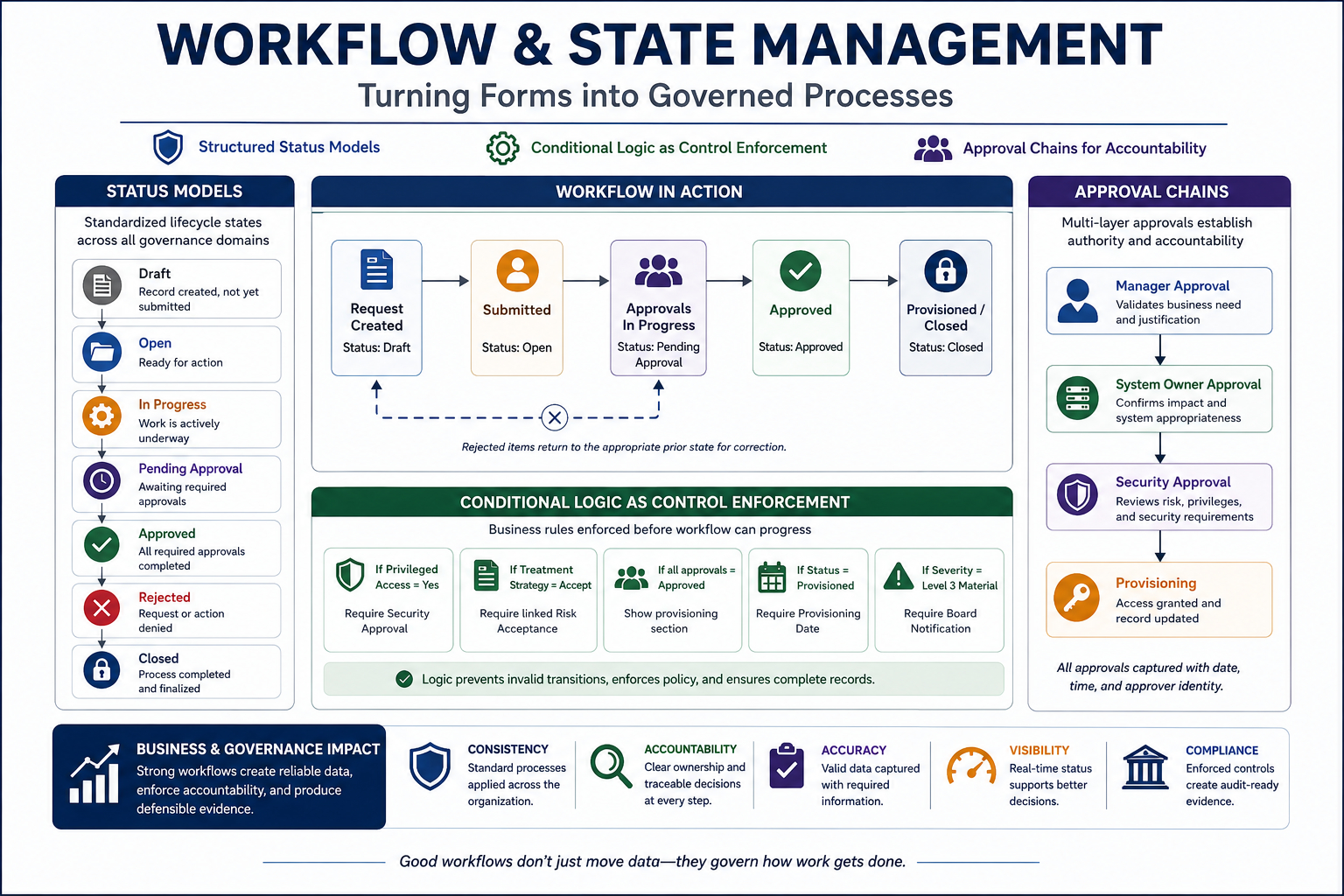
The blueprint standardizes status values throughout the platform:
- Draft
- Open
- In Progress
- Pending Approval
- Approved
- Rejected
- Closed
This consistency matters more than many developers realize.
When status models are standardized:
- dashboards become coherent,
- automation becomes predictable,
- filtering becomes reliable,
- and reporting logic becomes reusable.
Without standardization, every form invents its own vocabulary:
- “Done”
- “Complete”
- “Resolved”
- “Finished”
- “Mostly Fine”
- “Steve said it’s okay”
At that point, governance reporting becomes interpretive fiction.
Workflow as a Controlled Sequence
Workflows are fundamentally about transitions between states.
A workflow answers:
- What can happen next?
- Who is allowed to perform that action?
- Under what conditions?
- What evidence must exist first?
This is where conditional logic becomes essential.
The blueprint uses conditional logic repeatedly as an enforcement mechanism.
Examples include:
- If Treatment Strategy = Accept → require linked Risk Acceptance record
- If Privileged Access = Yes → require Security Approval
- If all approvals = Approved → display provisioning section
- If Status = Provisioned → require Provisioning Date
- If Current Severity = Level 3 Material → require Board Notification
- If Regulatory Impact = Yes → require Legal Counsel Engaged
These are not presentation rules.
They are governance controls.
That distinction matters.
Conditional Logic as Control Enforcement
Most developers think of conditional logic as a UI convenience:
- showing fields,
- hiding sections,
- improving user experience.
In enterprise systems, conditional logic often serves a much more important role:
Control enforcement.
The logic determines whether governance requirements are satisfied before a workflow can progress.
That means conditional logic becomes:
- a policy implementation layer,
- a procedural safeguard,
- and sometimes even evidence of oversight discipline.
Consider privileged access requests.
Without enforcement logic:
- a user could provision privileged access immediately,
- bypass approvals,
- and leave no structured governance trail.
With enforcement logic:
- privileged access triggers security review,
- provisioning is blocked until approvals exist,
- and status progression reflects actual authorization.
The system itself becomes part of the control structure.
This is one of the most important architectural transitions in the series.
The forms are no longer passive containers.
They are enforcing operational behavior.
Approval Chains: Modeling Authority
Approval workflows are fundamentally about authority delegation.
Who is authorized to approve:
- access?
- risk acceptance?
- remediation closure?
- incident escalation?
This is where many systems become dangerously ambiguous.
A surprising number of business applications rely on:
- informal approvals,
- email threads,
- chat confirmations,
- or “we discussed it on a call.”
None of those scale well into governance evidence.
The Access Requests workflow demonstrates a stronger pattern:
- Manager Approval
- System Owner Approval
- Security Approval
- Provisioning Assignment
Each approval stage:
- identifies responsible parties,
- captures workflow progression,
- and preserves traceability.
That matters because governance is not simply about what was done.
It is about:
- who authorized it,
- under what conditions,
- and whether proper oversight occurred.
Approval chains formalize that accountability.
State Management and Reporting
One of the hidden benefits of strong workflow modeling is reporting accuracy.
Dashboards become meaningful because states are trustworthy.
For example:
- “Pending Approval” actually means approvals are incomplete.
- “Provisioned” actually means provisioning occurred.
- “Closed” actually means remediation or resolution was completed.
Without enforced state integrity, dashboards become optimistic storytelling devices.
With enforced state integrity, dashboards become operational truth.
This is particularly important in governance systems because executives, auditors, and boards rely on status summaries to evaluate exposure and readiness.
The credibility of the reporting layer depends entirely on the integrity of the workflow layer beneath it.
Workflow Architecture in Formidable Forms
Formidable Forms provides several architectural advantages here:
- Conditional logic for workflow gating
- Dynamic Lookups for approver relationships
- Child forms for historical tracking
- Views for workflow reporting
- Status fields for lifecycle modeling
Combined properly, these features create:
- approval systems,
- escalation workflows,
- review cycles,
- and evidence-producing operational processes.
Again, the limitation is rarely the tool.
The limitation is usually whether the workflow was modeled intentionally.
The Emerging Pattern
By now, a clear architectural pattern is emerging across the series:
Entities establish structure.
Domains establish operational scope.
Workflow establishes behavior.
State establishes truth.
This layering is what transforms a WordPress application from:
- a data collection system
into:
- a governance platform capable of enforcing controlled processes.
That is a significant architectural distinction.
Common Workflow Design Mistakes
There are several anti-patterns developers should avoid immediately.
1. Overloading Statuses
Trying to represent too many concepts in a single status field creates ambiguity.
Status should represent lifecycle state—not emotional interpretation.
2. Workflow Without Enforcement
If users can bypass approvals or manually jump states, the workflow becomes performative rather than authoritative.
3. Hidden State Logic
Complex state transitions without documentation become impossible to maintain.
If a developer cannot explain the workflow clearly, the users certainly cannot.
4. Approval Without Accountability
An approval chain without clearly identified approvers is not governance.
It is theater with dropdowns.
Why This Matters Beyond Compliance
It would be easy to frame all of this purely as audit preparation or regulatory alignment.
That would undersell the architectural importance.
Strong workflow systems improve:
- operational consistency,
- reporting reliability,
- escalation discipline,
- and organizational accountability.
They reduce ambiguity.
And ambiguity is where governance failures quietly multiply.
Closing Thought
A form captures information.
A workflow governs behavior.
That difference is what this article is really about.
Status models define operational truth.
Conditional logic enforces control requirements.
Approval chains establish accountable authority.
Together, they transform a relational application into a governed system capable of demonstrating not just activity—but disciplined operational oversight.
Next week, we will move into one of the most important architectural layers in the platform: decision traceability and historical accountability through reviews, decisions, and evidence preservation.

Leave a Reply