
At this point in the series, the platform has become structurally mature.
We have:
- relational architecture,
- core entities,
- governance domains,
- workflow enforcement,
- and historical traceability.
But enterprise governance systems are ultimately judged by one capability above all others:
Can they produce defensible evidence quickly and consistently?
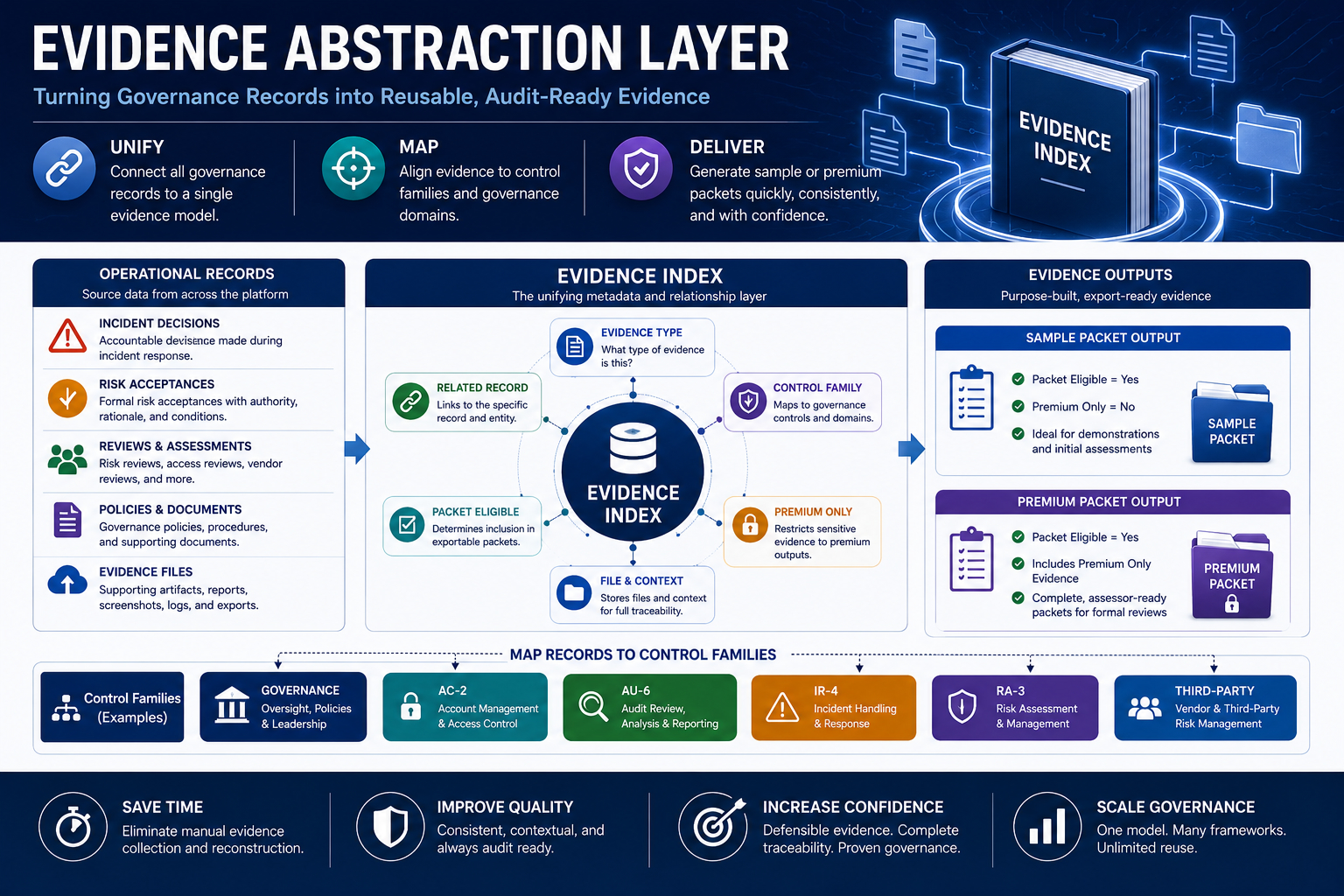
This is where the Evidence Abstraction Layer enters the architecture.
Without it, organizations are forced to reconstruct evidence manually every time:
- an audit occurs,
- an assessor requests documentation,
- a regulator asks questions,
- or leadership needs proof of oversight.
That reconstruction process is expensive, inconsistent, and fragile.
The goal of this layer is different.
Instead of rebuilding evidence after the fact, the system continuously transforms operational records into reusable evidence artifacts as governance activity occurs.
That architectural distinction changes everything.
- Why Evidence Abstraction Matters
- The Evidence Index: A Unifying Model
- From Operational Records to Governance Evidence
- Mapping Records to Control Families
- Evidence Relationships and Context
- Differentiating Sample vs Premium Outputs
- Export Logic as an Architectural Capability
- Why This Layer Changes the Entire System
- Formidable Forms as an Evidence Platform
- Common Evidence Architecture Mistakes
- The Larger Architectural Pattern
- Closing Thought
Why Evidence Abstraction Matters
Most organizations already possess enormous amounts of governance data.
The real problem is fragmentation.
Evidence is scattered across:
- spreadsheets,
- PDFs,
- tickets,
- email threads,
- meeting notes,
- cloud drives,
- and disconnected systems.
As a result, organizations frequently know:
- the information exists,
but cannot reliably:
- locate it,
- connect it,
- contextualize it,
- or package it efficiently.
The Evidence Abstraction Layer solves this by creating a unified evidence model across the entire platform.
The implementation blueprint defines this explicitly through the Evidence Index form, whose purpose is to:
- map evidence artifacts to controls,
- organize packet outputs,
- and support export workflows.
This transforms evidence from:
- scattered operational residue
into:
- structured governance assets.
The Evidence Index: A Unifying Model
The Evidence Index is one of the most important architectural abstractions in the entire system.
It acts as a centralized metadata layer that connects governance records to:
- control families,
- related records,
- evidence types,
- packet eligibility,
- and export readiness.
This means the platform is no longer simply storing:
- risks,
- incidents,
- approvals,
- reviews,
- or policies.
It is classifying them as evidence.
That distinction is foundational.
The Evidence Index includes fields such as:
- Evidence Type
- Related Control Family
- Related Record Type
- Related Record ID
- Packet Eligible
- Premium Only
- Last Updated
- File Upload
This structure creates a reusable abstraction layer across all governance domains.
The same underlying operational records can now support:
- dashboards,
- assessor packets,
- governance reviews,
- audit responses,
- and executive reporting.
Without duplication.
Without reconstruction.
Without starting over every time someone asks for proof.
From Operational Records to Governance Evidence
This is where the architecture becomes significantly more sophisticated.
A Risk Acceptance is no longer merely:
- a workflow record.
It becomes:
- evidence of executive risk acknowledgment.
An Incident Decision is no longer merely:
- a timeline entry.
It becomes:
- evidence of accountable escalation and response.
An Access Review is no longer merely:
- an operational certification.
It becomes:
- evidence of periodic access governance.
The Evidence Index provides the unifying structure that allows all of these records to participate in a common evidentiary model.
This is one of the defining characteristics of mature governance platforms:
Operational activity and governance evidence become directly connected.
Mapping Records to Control Families
One of the most powerful capabilities in the platform is the ability to map records directly to governance domains and control families.
The blueprint defines control-family mappings such as:
- Governance
- AC-2
- AU-6
- IR-4
- RA-3
- Third-Party
This matters because evidence rarely exists in isolation.
Assessors, auditors, and governance stakeholders typically evaluate evidence within the context of:
- controls,
- frameworks,
- and oversight expectations.
The platform therefore allows records to become:
- framework-aware.
For example:
- Risk Reviews map to RA-3
- Access Reviews map to AC-2
- Alert Reviews map to AU-6
- Incident Decisions map to IR-4
This creates an architecture where evidence can be grouped dynamically by:
- control family,
- governance domain,
- or assessment scope.
That is enormously valuable operationally.
Instead of manually assembling evidence packets, the system can query:
“Show all packet-eligible evidence for AU-6.”
That is the kind of architectural leverage enterprise systems are supposed to provide.
Evidence Relationships and Context
One of the most overlooked problems in governance programs is evidence without context.
A PDF alone is not governance evidence.
The important question is:
“What does this document prove?”
The Evidence Index solves this by preserving relationships.
Each evidence record references:
- related record types,
- related entities,
- related control families,
- and descriptive context.
That means evidence is not merely stored.
It is contextualized.
This allows the system to answer:
- What control does this support?
- Which risk does this relate to?
- Which incident produced this artifact?
- Which review cycle generated this evidence?
- Which governance process created it?
Without contextual linkage, evidence becomes difficult to defend.
With contextual linkage, evidence becomes narrative.
And governance is fundamentally about narrative integrity under scrutiny.
Differentiating Sample vs Premium Outputs
This is another highly strategic architectural layer in the system.
Not all evidence should be exposed equally.
The blueprint distinguishes between:
- Packet Eligible
- Premium Only
This enables multiple output tiers:
- sample evidence packets,
- premium readiness artifacts,
- internal-only governance records,
- assessor-facing exports.
This is not simply a marketing distinction.
It is an abstraction strategy.
The same governance system can now produce:
- lightweight demonstrations,
- sanitized examples,
- or enterprise-grade evidence packages
without duplicating records or maintaining separate systems.
That separation is extremely important commercially.
A sample packet demonstrates capability.
A premium packet demonstrates operational maturity.
The architecture supports both simultaneously.
Export Logic as an Architectural Capability
The blueprint defines explicit export behavior:
Sample Packet Export:
- Packet Eligible = Yes
- Premium Only = No
Premium Packet Export:
- Packet Eligible = Yes
This is another major architectural shift.
The platform is no longer simply:
- storing governance data.
It is now:
- generating reusable governance products.
That distinction matters because evidence generation is often where organizations incur massive operational overhead.
When evidence abstraction is designed properly:
- export becomes systematic,
- not manual.
Why This Layer Changes the Entire System
At this point in the architecture, the platform crosses into a fundamentally different category.
It is no longer merely:
- relational,
- workflow-driven,
- or operationally governed.
It is now:
- evidence-oriented by design.
That means:
- every workflow,
- every review,
- every approval,
- every escalation,
- every decision
can potentially become reusable governance evidence.
This is the architectural differentiator behind the entire platform.
Not forms.
Not dashboards.
Not workflows.
Evidence continuity.
Formidable Forms as an Evidence Platform
This is another area where Formidable becomes significantly more capable than many developers initially realize.
Using:
- relational entities,
- Views,
- Dynamic Lookups,
- file uploads,
- child forms,
- exportable data structures,
- and conditional visibility,
the platform can support:
- evidence indexing,
- framework mapping,
- export generation,
- and governance packet assembly.
The architecture is effectively transforming Formidable into:
- an evidence management layer for enterprise governance.
Again, the key is not the plugin itself.
The key is whether the system was modeled intentionally around evidence continuity.
Common Evidence Architecture Mistakes
Several anti-patterns undermine evidence systems quickly.
1. Evidence Without Metadata
A document without classification, relationships, or control mapping is difficult to operationalize.
2. Duplicate Evidence Repositories
Maintaining separate evidence stores creates synchronization problems immediately.
3. Manual Packet Assembly
If evidence packaging depends entirely on human reconstruction, scalability suffers dramatically.
4. Static Evidence Models
Evidence should evolve dynamically from operational activity—not exist as isolated uploads.
The Larger Architectural Pattern
The deeper pattern across the series is now fully visible.
Entities create structure.
Domains create operational context.
Workflows enforce governance.
Traceability preserves accountability.
Evidence abstraction creates defensibility.
Each layer builds on the previous one.
And together, they transform the application into:
- a continuously operating governance evidence platform.
Closing Thought
Most systems produce data.
Mature governance systems produce evidence.
That distinction is what the Evidence Abstraction Layer is designed to solve.
The Evidence Index unifies governance records into a reusable evidence model.
Control-family mappings connect operational activity to oversight frameworks.
Sample and premium outputs allow the same architecture to support multiple levels of organizational maturity and engagement.
At this stage, the system is no longer merely documenting governance.
It is operationalizing evidentiary oversight itself.
Next week, we will move into Views as Application Interfaces—where dashboards, executive summaries, and operational reporting layers transform relational governance data into decision-support systems for leaders, reviewers, and assessors.

Leave a Reply