
Every application appears scalable at small scale.
A few forms.
A few hundred entries.
Minimal relationships.
Simple Views.
At that stage, almost every architectural decision feels acceptable.
Enterprise systems expose reality.
As governance platforms mature, they begin accumulating:
- deeply relational datasets,
- historical traceability,
- workflow histories,
- evidence mappings,
- approval chains,
- operational dashboards,
- and cross-domain reporting dependencies.
Eventually, performance stops being theoretical.
Views slow down.
Queries multiply.
Dashboard latency increases.
Exports become expensive.
Administrators begin saying:
“It was fast when we launched.”
This is the point where developers must understand something fundamental about Formidable Forms that is often overlooked entirely:
Formidable’s scalability characteristics are deeply tied to the architecture of its metadata query engine.
And more importantly:
Enterprise developers can override many of those limitations directly.
That distinction changes everything.
- Understanding the Metadata Query Model
- Why LEFT JOIN Explosion Matters
- The Most Important Enterprise Performance Hook in Formidable
- Moving Beyond Metadata Constraints
- Operational Data Stores (ODS) in Formidable
- SQL Views and Relational Projection Layers
- Star Schemas and Dimensional Modeling
- View Optimization Strategies Revisited
- Why This Changes the Enterprise Conversation
- The Real Enterprise Differentiator
- Closing Thought
Understanding the Metadata Query Model
Formidable Forms stores field values using WordPress’s metadata architecture.
At a high level:
- entries become parent records,
- field values become metadata rows,
- and relational behavior is achieved through metadata lookups and query orchestration.
This creates extraordinary flexibility.
It also creates significant query complexity at scale.
What many developers do not realize is how Formidable’s View query generator actually operates internally.
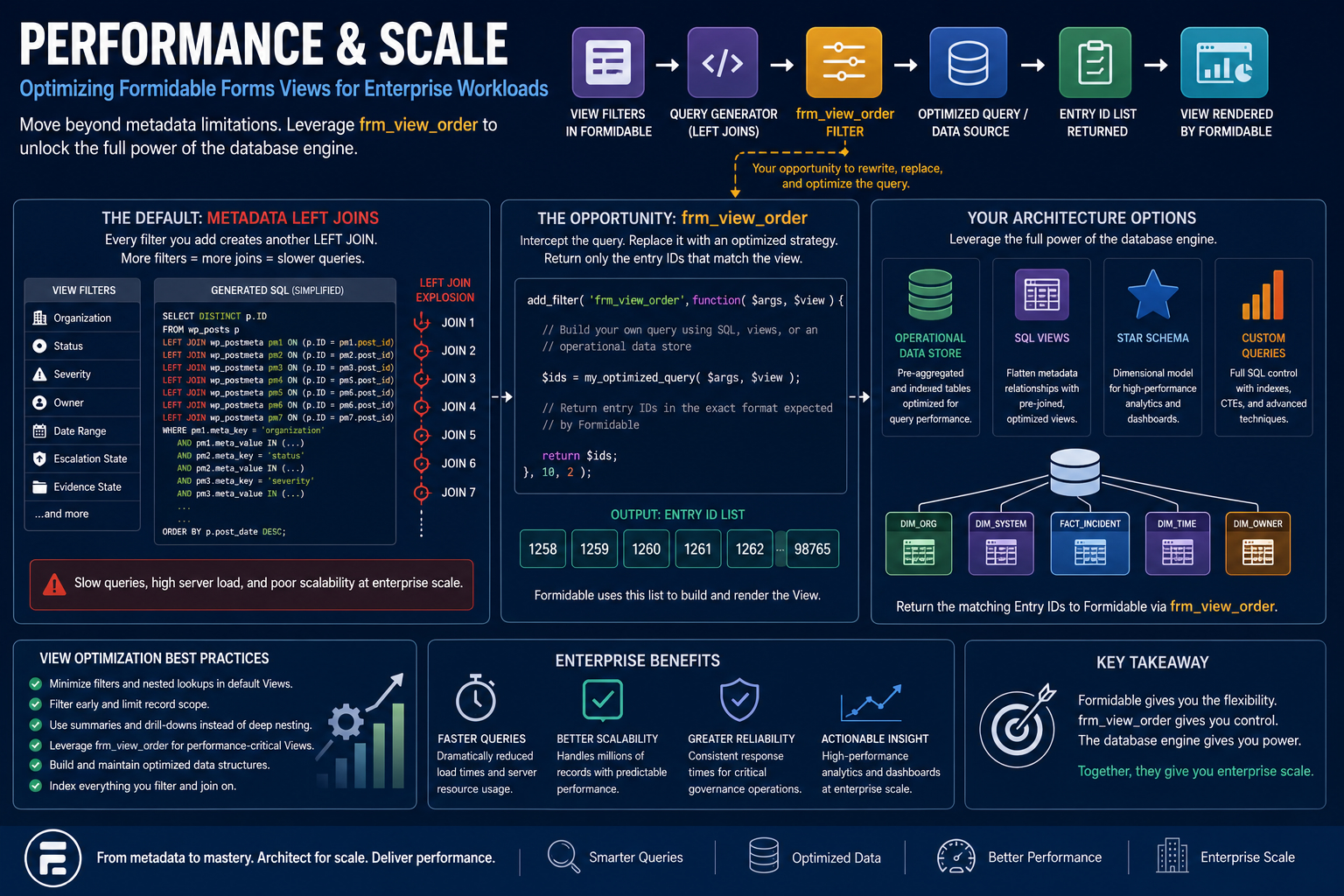
Every View filter added through the Formidable interface becomes an additional SQL LEFT JOIN.
That means a moderately complex View containing:
- status filters,
- organization filters,
- role filters,
- date filters,
- relationship filters,
- and conditional logic
can easily generate a query containing large numbers of metadata joins.
This is not a theoretical concern.
It is one of the central scalability constraints of metadata-driven architectures.
The more filters added:
→ the more joins generated
→ the more metadata traversal required
→ the more expensive the query becomes
At small scale, this is manageable.
At enterprise scale, this becomes one of the defining architectural bottlenecks of the system.
Why LEFT JOIN Explosion Matters
Metadata architectures inherently trade:
- schema flexibility
for:
- query efficiency.
Each additional filter requires another metadata relationship lookup.
This creates what enterprise developers eventually recognize as:
- join amplification.
For example:
A View filtering:
- Organization
- Status
- Severity
- Risk Owner
- Date Range
- Escalation State
- Evidence State
does not generate:
- one elegant relational query.
It generates:
- multiple metadata-based
LEFT JOINoperations across the Formidable entry meta tables.
That distinction is critically important.
The issue is not merely:
- “too much data.”
The issue is:
- relational inefficiency introduced by metadata traversal patterns.
This is the point where many developers incorrectly assume:
“Formidable cannot scale.”
That conclusion is incomplete.
Because there is another layer to the architecture.
The Most Important Enterprise Performance Hook in Formidable
Formidable exposes a filter named:frm_view_order
This filter is one of the most strategically important extension points in the entire platform.
Why?
Because it exposes Formidable’s fully generated query structure to the developer before execution.
More importantly:
the developer can completely rewrite the query behavior.
That changes the performance conversation entirely.
The key architectural insight is this:
The purpose of the View query engine is ultimately to return:
- a list of matching entry IDs.
Once the entry ID list is generated:
- Formidable renders the View from those IDs.
That means developers are not constrained to:
- metadata-generated
LEFT JOINlogic.
Instead, enterprise developers can:
- intercept the generated query,
- replace the retrieval strategy entirely,
- and return optimized entry ID sets using alternative relational models.
This effectively opens the full capabilities of the database engine itself to the developer.
That is an enormous architectural capability.
Moving Beyond Metadata Constraints
This is where enterprise architecture becomes possible inside Formidable Forms.
Instead of relying entirely on:
- metadata joins,
developers can construct:
- operational data stores,
- relational aggregation tables,
- SQL Views,
- reporting indexes,
- or dimensional models
specifically optimized for query performance.
The metadata schema still powers:
- entry management,
- workflow logic,
- and relational application behavior.
But performance-critical Views can retrieve:
- optimized entry ID lists
from entirely different structures.
That is a radically different architectural model than most developers realize is possible.
Operational Data Stores (ODS) in Formidable
One of the most effective enterprise strategies is constructing:
- an Operational Data Store (ODS).
In this model:
- Formidable remains the operational workflow engine,
- while optimized relational structures support reporting and dashboard performance.
For example:
- nightly synchronization,
- trigger-based updates,
- or incremental replication
can populate:
- flattened relational reporting tables.
Those tables can then:
- calculate aggregations,
- preserve dimensional relationships,
- eliminate metadata joins,
- and dramatically reduce query complexity.
The frm_view_order filter then becomes the interception layer that redirects View retrieval logic toward the optimized relational structure.
This effectively transforms Formidable into:
- a hybrid metadata-relational architecture.
That is an extremely powerful design pattern.
SQL Views and Relational Projection Layers
Another important strategy involves SQL Views directly.
Rather than querying:
- fragmented metadata tables repeatedly,
developers can construct:
- relational SQL Views
that: - normalize metadata relationships,
- flatten common joins,
- and expose optimized reporting structures.
This creates:
- pre-joined relational projections
that dramatically reduce query cost.
Instead of:
- dynamically rebuilding joins repeatedly through metadata traversal,
the database engine handles:
- relational optimization directly.
This is where experienced enterprise developers can fully exploit:
- indexes,
- execution plans,
- materialized structures,
- and relational optimization strategies.
At this level, Formidable stops behaving like:
- “a forms plugin.”
It becomes:
- an application orchestration layer sitting on top of a highly optimized relational reporting model.
That distinction is critical.
Star Schemas and Dimensional Modeling
This is where the architecture becomes especially interesting.
Because the View engine ultimately consumes:
- entry ID lists,
developers can implement:
- true dimensional reporting structures underneath the platform.
That means:
- star schemas,
- fact tables,
- dimension tables,
- governance metrics layers,
- and enterprise reporting cubes
can all participate in the architecture.
For example:
Fact tables may track:
- incidents,
- risk events,
- approvals,
- escalations,
- evidence exports.
Dimension tables may define:
- organizations,
- systems,
- owners,
- time periods,
- control families,
- governance domains.
The resulting architecture allows:
- high-performance governance analytics
while still preserving: - Formidable’s workflow and application flexibility.
This is an extraordinarily important enterprise capability.
It effectively bypasses many of the traditional limitations associated with metadata-driven WordPress applications.
View Optimization Strategies Revisited
Once developers understand the architecture properly, View optimization becomes much more sophisticated.
1. Treat Metadata Queries as a Default — Not a Limitation
The built-in query generator is useful.
It is not mandatory for enterprise-scale retrieval strategies.
2. Use frm_view_orderas an Enterprise Query Layer
This filter enables:
- complete query replacement,
- optimized entry retrieval,
- and integration with relational reporting structures.
This is arguably one of the most important advanced hooks in the entire Formidable ecosystem.
3. Separate Workflow Storage from Reporting Retrieval
Operational workflows and reporting systems have different optimization requirements.
Trying to optimize both simultaneously from raw metadata structures creates scaling problems quickly.
4. Build Relational Projection Layers
SQL Views and ODS layers allow:
- flattened reporting,
- optimized indexing,
- and reduced join complexity.
5. Use Dimensional Modeling for Governance Analytics
Star schemas become especially powerful for:
- dashboards,
- executive reporting,
- trend analysis,
- and evidence aggregation.
This is how developers move beyond:
- metadata-bound thinking.
Why This Changes the Enterprise Conversation
This architectural capability fundamentally changes how Formidable should be evaluated.
Most developers only see:
- the metadata layer.
Experienced enterprise developers recognize:
- the extensibility layer beneath it.
That is where true scalability emerges.
The important realization is this:
Formidable’s workflow engine and application framework do not need to be abandoned simply because metadata querying has scaling constraints.
Instead:
- the relational retrieval strategy can evolve independently.
This creates a hybrid architecture where:
- Formidable manages operational application behavior,
while: - optimized relational structures manage enterprise reporting and retrieval performance.
That is a very different architectural conversation than:
“WordPress can’t scale.”
The Real Enterprise Differentiator
This is ultimately where experienced enterprise developers separate themselves from:
- plugin assemblers.
Most developers stay constrained within:
- the UI abstraction layer.
Enterprise developers understand:
- the database engine itself is still fully available.
That means:
- query optimization,
- relational modeling,
- indexing,
- dimensional analytics,
- materialized structures,
- and reporting abstraction layers
can all be introduced beneath the application framework.
This is the architectural frontier where Formidable becomes capable of supporting:
- sophisticated enterprise governance systems,
- operational intelligence platforms,
- and large-scale evidence architectures.
Closing Thought
Metadata architectures are extraordinarily flexible.
But flexibility is not the same thing as scalability.
Enterprise performance begins when developers stop treating generated metadata queries as immutable.
Formidable’s frm_view_order filter exposes something much larger than a sorting hook.
It exposes the gateway to the full relational capabilities of the database engine itself.
That means:
- operational data stores,
- SQL Views,
- dimensional models,
- star schemas,
- and optimized reporting layers
can all participate in the architecture while Formidable continues managing workflows, relationships, evidence, and governance operations.
At that point, the conversation changes completely.
The question is no longer:
“Can Formidable scale?”
The real question becomes:
“How far is the developer willing to push the underlying database architecture?”

Wow, Victor, there is so much depth here in how you’re unpacking what sits beneath the surface of “scalability.”
What stands out to me most is the reminder that performance is never just technical. It is also relational, architectural, and deeply dependent on how we choose to design for complexity over time.
From a Caritas lens, I keep coming back to this idea that systems should serve life, not constrain it. Even in something as technical as metadata models and query structures, there is a human story underneath it, people relying on systems to hold work, evidence, accountability, and care.
Your framing of separating operational workflows from reporting and allowing each to evolve in its own integrity feels important. It reflects a kind of respect for both structure and emergence at the same time.
In many ways, this is the same challenge we see in healthcare systems. What works beautifully at launch begins to strain under real-world complexity unless we are willing to rethink the foundation, not just the surface issues.
Appreciate how you push the thinking beyond “it doesn’t scale” into “what becomes possible when we redesign how we think about scale in the first place.”
Darlene, thank you for such a thoughtful reflection. I especially appreciated your observation that performance isn’t just a technical concern—it reflects the relationships between people, processes, and the systems they depend on.
I also like your phrase, “systems should serve life, not constrain it.” That’s true whether we’re talking about healthcare, governance, or enterprise software. Good architecture creates room for growth instead of forcing organizations to continually work around yesterday’s design decisions.
One of the reasons I wanted to write this article is that many developers assume they’ve reached the limits of Formidable Forms when, in reality, they’ve reached the limits of a particular query strategy. Once you recognize that the platform ultimately consumes a list of entry IDs, entirely new architectural possibilities open up by leveraging the relational database engine directly.
Thanks for adding a perspective that reminds us technical architecture ultimately exists to serve people.