
The moment a Formidable build starts carrying real business weight, the conversation has to change.
At the beginner level, most builds are organized around forms, fields, and entries. That is perfectly fine for intake screens, lead capture, or one-off workflows. But the moment you need traceability, reporting consistency, reusable records, or defensible outputs, that model starts to crack.
Why?
Because enterprise systems are not built around isolated submissions. They are built around relationships.
That is the architectural threshold this article addresses.
In this series, we are not using Formidable Forms as a set of disconnected interfaces. We are using it as the relational backbone for a governance application. The implementation blueprint makes that explicit: the system must maintain relational integrity between records and be built as one integrated governance application, not a collection of unrelated forms.
That is where data architecture stops being an implementation detail and becomes the whole game.
Why Relational Modeling Matters
A flat form can collect data.
A relational system can explain it.
That distinction matters more than many developers realize. A governance system has to answer questions such as:
- Which organization owns this system?
- Who approved this risk acceptance?
- Which incident decisions belong to this incident?
- Which vendor review supports this evidence packet?
- Which remediation action closes which finding?
Those are not field questions. They are relationship questions.
If the data is not modeled relationally, every dashboard, report, packet, and audit trail becomes harder to build and easier to break. Developers then compensate with duplicated fields, manual cross-references, and fragile Views logic. That is usually the point where “simple” turns into “mysteriously awful.”
Relational design avoids that trap by making the structure explicit from the start.
The Parent Entity: Start with the Root
Every serious system needs a root context.
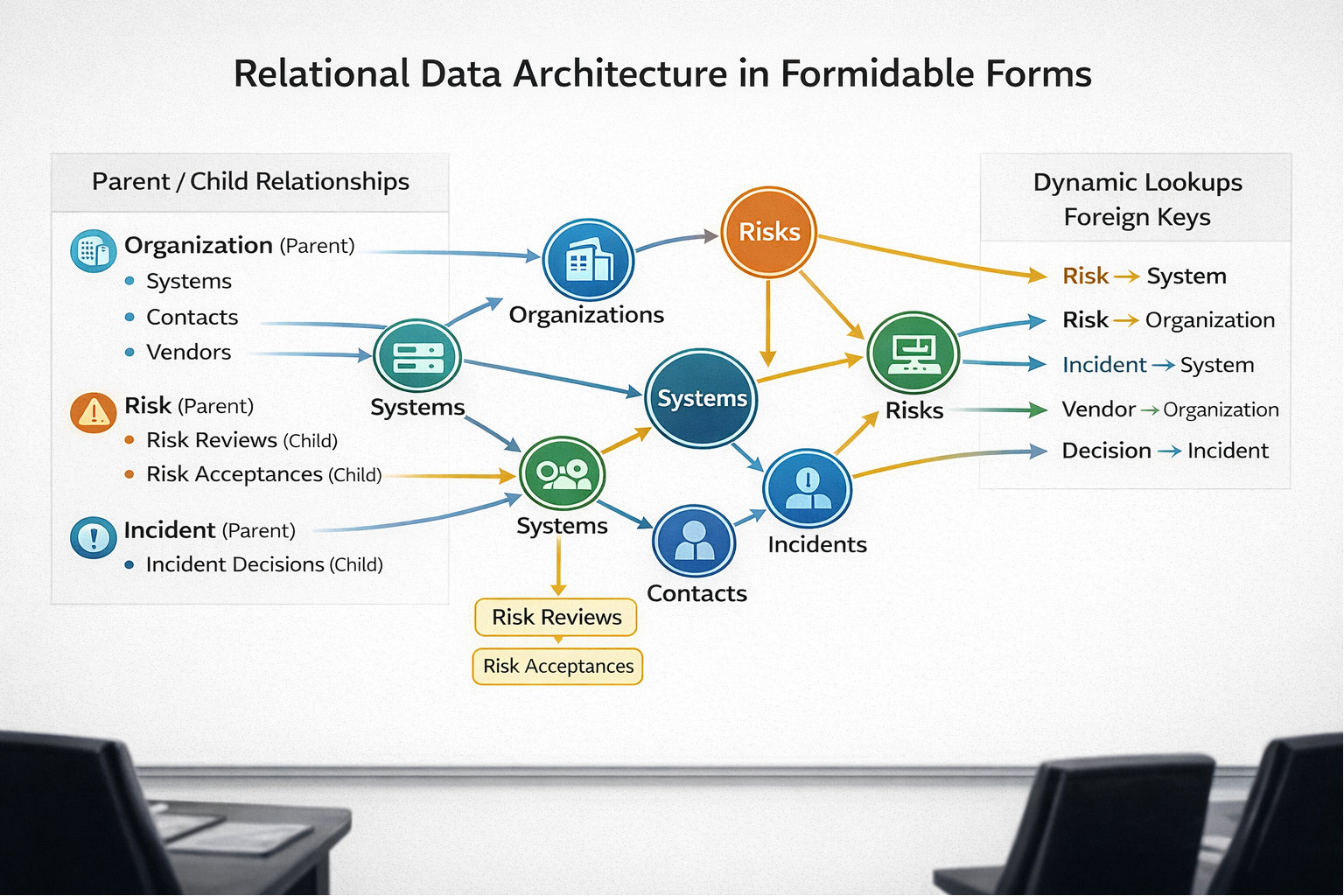
In this project, that root is the Organization. The implementation document defines Organizations as the root parent for almost all records, which means the entire application hangs from a top-level organizational anchor.
This is not just tidy architecture. It is what makes filtering, scoping, and reporting coherent.
Once Organization is the parent context, nearly every downstream record can inherit its meaning:
- A risk belongs to an organization.
- A system belongs to an organization.
- A vendor belongs to an organization.
- An incident belongs to an organization.
- An evidence artifact belongs to an organization.
That gives you a stable top-level filter across the entire application.
Without that root, your Views become a scavenger hunt.
With it, you can build organization-specific dashboards, reports, and exports without resorting to duct tape and prayer.
Parent/Child Structures: Modeling History, Not Just State
Relational systems do not only connect peers. They also preserve history.
That is where parent/child structures become essential.
The blueprint identifies several direct parent/child relationships:
- Risks are the parent for Risk Reviews and Risk Acceptances.
- Incidents are the parent for Incident Decisions.
- Vendors are the parent for Vendor Reviews.
- Audit Findings are the parent for Remediation Actions.
This is more than a convenience. It is how the system preserves lifecycle context.
Take Risks as an example. The parent Risk record represents the enduring scenario. Risk Reviews then capture reassessment history over time. Risk Acceptances capture explicit decisions when treatment strategy shifts into formal acceptance. That means the system can distinguish between the current state of a risk and the history of how that state evolved. The same pattern appears again with incidents and their decisions, and with findings and their remediation actions.
That distinction is critical in governance work.
A snapshot tells you what exists now.
A parent/child structure tells you how it got there.
And in audit, oversight, or litigation-adjacent environments, “how it got there” is usually where the real story lives.
Dynamic Lookups as Foreign Keys
This is the point where many Formidable developers accidentally reinvent relational databases without admitting it.
Formidable’s Dynamic Lookup field is doing the work of a foreign key.
Not in a strict SQL-engine sense, of course. WordPress and Formidable are not pretending to be PostgreSQL in a three-piece suit. But architecturally, the role is the same: a record in one form references a record in another form to preserve relationship integrity.
The implementation blueprint specifically includes Dynamic Lookup as a core field type and uses it repeatedly across the system:
- Organizations reference consultants and sponsors with Dynamic Lookups.
- Contacts reference Organizations.
- Systems reference Organizations and owners.
- Risks reference Organizations, Systems, Business Processes, and Risk Owners.
- Risk Reviews reference Parent Risks.
- Incident Decisions reference Parent Incidents.
- Vendor Reviews reference Parent Vendors.
- Remediation Actions reference Parent Findings.
That is not incidental usage. That is the architecture.
When you use Dynamic Lookups this way, you stop duplicating names and start referencing records. That gives you three major advantages.
First, consistency. If a system owner changes title or email, you update one Contact record, not seventeen forms and four apologetic spreadsheets.
Second, reportability. Views can pull related records reliably because the connection is explicit.
Third, reuse. The same Contact can serve as a decision owner, reviewer, approver, consultant, or vendor contact across different workflows without spawning duplicate identity records all over the application like rabbits on espresso.
Modeling Entities Before Interfaces
One of the most common architectural mistakes in Formidable projects is designing forms before designing entities.
That approach feels productive because you can see the screen quickly. But it usually leads to a structure based on what users type rather than what the system needs to know.
The better sequence is the opposite.
Start by identifying the core entities:
Organizations, Contacts, Systems, Risks, Incidents, Vendors, Findings, Evidence.
Then identify the subordinate entities:
Risk Reviews, Risk Acceptances, Incident Decisions, Vendor Reviews, Remediation Actions.
Then define the relationships between them.
Only after that should you worry about how the forms look.
This project’s recommended build sequence reflects exactly that logic, beginning with Organizations, then Users Contacts, then Systems Assets, then Risks and their related child forms, followed by the other governance domains.
That sequence is not arbitrary. It is the order required to establish references cleanly.
You cannot build reliable child records before the parents exist.
You cannot build useful dynamic lookups before the referenced entities are stable.
You cannot build good Views on top of bad relationships.
Architecture, as usual, is the thing people want to skip right before they discover why they needed it.
What This Looks Like in Practice
Consider a single incident.
In a flat build, you might store the incident description, owner, status, and several decision notes in one large form. That may work at first. But it quickly becomes brittle. Every new decision requires more repeating fields or overwriting old information. Historical sequencing becomes awkward. Reporting becomes inconsistent.
In a relational build, the pattern is cleaner:
- The Incident is the parent record.
- Each Incident Decision is its own child record.
- Each decision references the parent incident through a Dynamic Lookup.
- The decision owner is also a referenced Contact.
- Affected systems are referenced System records.
- Related processes are referenced Process records.
Now the system can show an incident summary, a decision timeline, accountable owners, affected assets, and related governance context without forcing all of that into one form entry like a family of five trying to fit into a sports car.
The same logic scales across risks, vendor oversight, and remediation tracking.
Relational Design Changes the Output Layer
The real payoff of relational modeling is not just cleaner data. It is better outputs.
Because the records are connected, the application can produce:
- organization-scoped dashboards,
- risk histories,
- incident decision timelines,
- vendor review schedules,
- and evidence packets grouped by control family.
This is where many developers realize the architecture was never “back-end only.” It directly determines what the system can prove.
A disconnected form build may still display data.
A relational build can reconstruct accountability.
That is a much more valuable capability.
Closing Thought
Relational architecture is the dividing line between a Formidable project that collects information and one that governs it.
Once you establish parent entities, child histories, and Dynamic Lookup relationships, the system stops behaving like a collection of entry screens and starts behaving like an application.
That is the shift this series is built around.
Next week, we will move from the abstract model into the first concrete layer of implementation: establishing the core entity stack with Organizations, Contacts, and Systems as the foundational records for the entire governance platform.

Leave a Reply