
By Victor M. Font Jr., Developers Corner
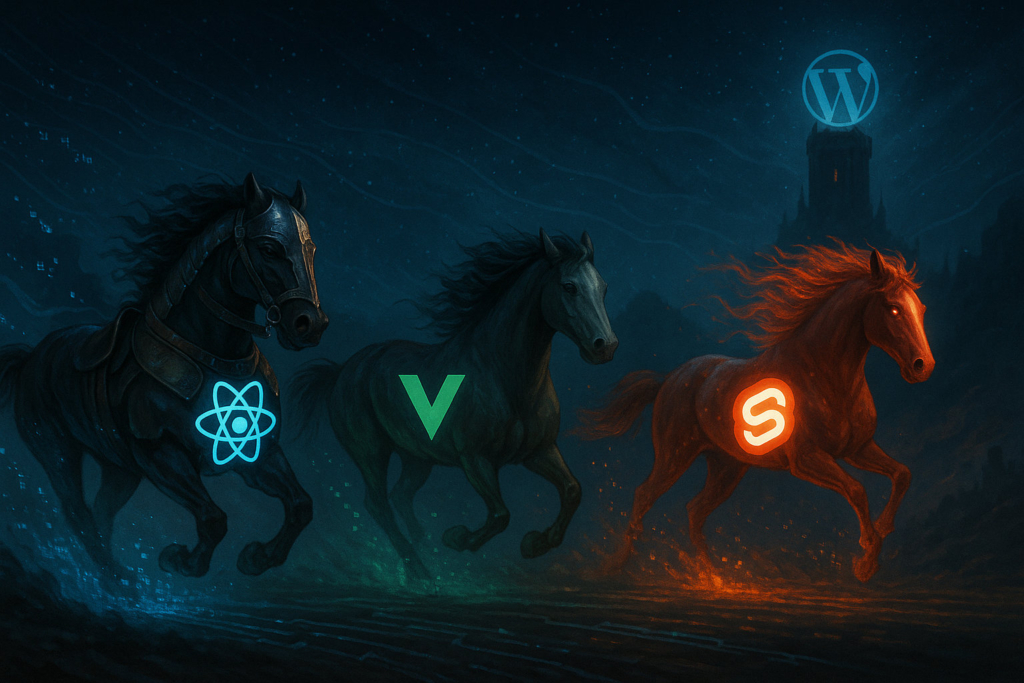
In our last two installments, we watched the WordPress Horseman lose his head—but not his horsepower. The backend remains alive and powerful, driven by APIs and structured by tools like Formidable Forms.
Now comes the question every headless architect must answer:
If WordPress is the horse…
What kind of frontend saddle do you want to ride on?
The headless ride demands a frontend framework worthy of the engine behind it. Today, we explore three modern stallions in the stable—React, Vue, and Svelte—each with its own gait, posture, and attitude.
Let’s cinch up and ride.
Why You Need a JavaScript Framework in the First Place
Traditional WordPress themes render UI with PHP. Once you go headless, your entire UI is driven by API responses. This means:
- You’re fetching content from WordPress (often via REST or GraphQL)
- You’re rendering interfaces dynamically using JavaScript
- You need state management, routing, and component lifecycles
This is why most developers turn to frontend frameworks like React, Vue, or Svelte.
Headless WordPress without a frontend framework is like a rider without reins—awkward, dangerous, and prone to getting lost in the trees.
1. React: The Enterprise Stallion
Best For: Large-scale apps, rich component ecosystems, teams already familiar with JS tooling.
React is the industry favorite for headless WordPress projects, especially in enterprise environments. Why?
- Deep integration with frontend build tools (Webpack, Vite)
- Battle-tested state management (Redux, Zustand, React Query)
- Tons of prebuilt UI component libraries
- Used in platforms like Gatsby and Next.js (which offer WordPress integration)
WordPress Tie-Ins:
- Gutenberg is built with React
- WPGraphQL and headless starter themes often cater to React
- Easy to manage client-side routing and hydration from API-loaded data
Downsides:
- Steep learning curve
- Boilerplate can bloat projects quickly
- Requires careful performance tuning
React is the Clydesdale of the headless world: powerful, dependable, but not lightweight.
2. Vue: The Agile Workhorse
Best For: Developers who want a balance of power and simplicity.
Vue is elegant, approachable, and surprisingly versatile. Its single-file component structure makes it ideal for teams transitioning from more traditional development stacks.
- Smooth learning curve with a gentle ramp-up
- Great for mid-size projects and internal apps
- Excellent documentation and tooling (Vue CLI, Vite, Nuxt)
- Native support for transitions and reactivity
WordPress Tie-Ins:
- Pairs well with REST APIs—no need for GraphQL to get started
- Can be easily embedded in legacy WordPress templates for hybrid architectures
- Nuxt (Vue’s full-stack framework) supports static generation and SSR
Downsides:
- Smaller ecosystem than React
- Not as commonly used in enterprise integrations (yet)
Vue is the thoroughbred: elegant, fast, and responsive—ideal for developers who like clean code and graceful performance.
3. Svelte: The Wild Mustang
Best For: Developers obsessed with performance and simplicity.
Svelte breaks with tradition by compiling components at build time. The result? Smaller bundles, blazing-fast rendering, and minimal runtime overhead.
- No virtual DOM = high-speed rendering
- Syntax is readable and minimal
- Strong support for reactive programming
- Paired with SvelteKit for routing and deployment
WordPress Tie-Ins:
- Fantastic for public-facing sites that fetch JSON content
- Clean for displaying Formidable Form entry data in small components or dashboards
- Can consume REST or GraphQL endpoints with minimal boilerplate
Downsides:
- Smaller community (but growing fast)
- Fewer enterprise-level integrations or starter kits
- Some advanced functionality still maturing (e.g., SSR edge cases)
Svelte is the Mustang—untamed, elegant, and lightning-quick. But it may buck the unwary rider.
Choosing the Right Ride for Your Stack
| Framework | Best Use Case | Learning Curve | Ecosystem Size | Performance |
|---|---|---|---|---|
| React | Large apps, component libraries | Steep | Huge | Medium |
| Vue | Mid-size, readable projects | Gentle | Medium | High |
| Svelte | Performance-driven apps | Gentle | Small (growing) | Highest |
Also consider:
- Your team’s familiarity with JS tooling
- The desired performance profile of the application
- Ecosystem maturity (especially for plugins or design systems)
- Deployment preferences (e.g., Vercel vs Netlify vs custom CI)
Formidable Forms in Any Framework
No matter which frontend you choose, your Formidable Forms data remains accessible:
- Use
fetch()oraxiosto GET entries from/wp-json/frm/v2/entries - POST new entries securely using token-based auth or a proxy endpoint
- Use repeaters, lookups, and calculated fields—logic handled server-side
Headless doesn’t mean helpless. Formidable keeps your structured data safe and centralized.
Headless Wisdom
“Choose your mount wisely. For in battle, the wrong ride will throw you.”
Takeaways:
- React, Vue, and Svelte are all valid choices for headless WordPress frontends.
- React offers maturity and scale; Vue provides balance and simplicity; Svelte offers speed and innovation.
- Formidable Forms integrates cleanly with all of them—your backend remains stable regardless of the frontend framework.
Next up: “Formidable Without a Face: Using Formidable Forms in a Headless Setup”— We’ll go deep into the REST API structure, authentication, and how to build fully interactive headless workflows using Formidable.

Leave a Reply