
Introduction
As WordPress developers, we often pride ourselves on speed—spinning up sites in hours, customizing themes and plugins on the fly, and deploying to production without the overhead of massive frameworks or rigid processes. But as the WordPress ecosystem continues to evolve beyond simple blogs and brochure sites into full-fledged applications, a new reality sets in: building enterprise-grade solutions requires more than code—it demands process.
That’s where the System Development Life Cycle (SDLC) comes in.
What Is the SDLC?
The SDLC is a structured framework that outlines the phases involved in developing software applications—from the initial idea to deployment and ongoing maintenance. It provides a disciplined approach to planning, designing, building, testing, and maintaining software systems.
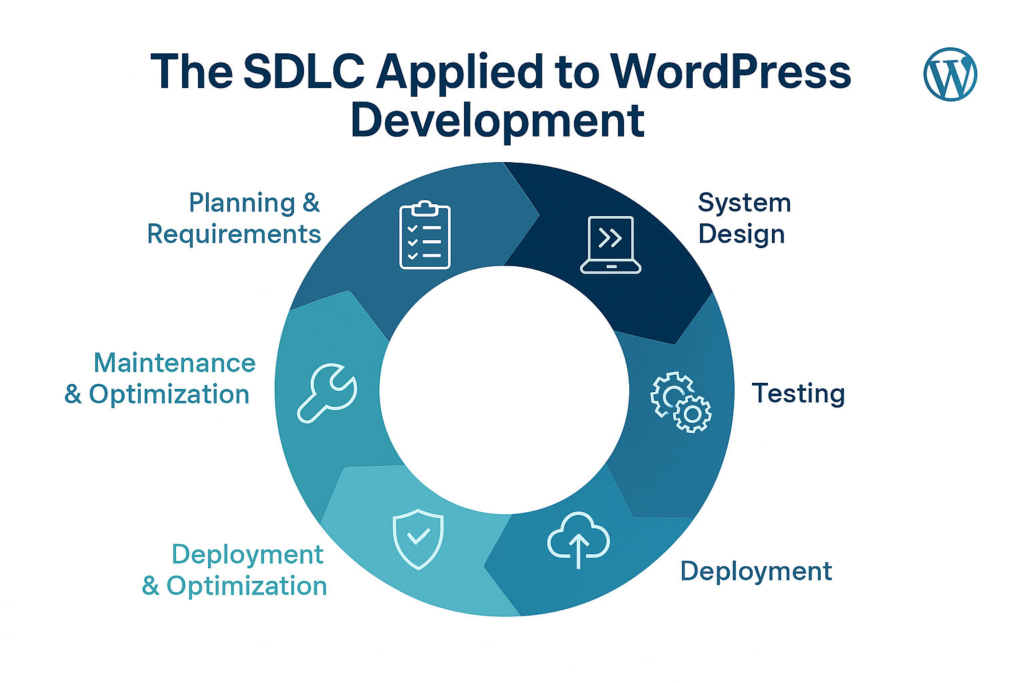
While there are many SDLC models (Waterfall, Agile, Spiral, etc.), they all share these common phases:
- Planning and Requirements Gathering
- System Design
- Development
- Testing and Quality Assurance
- Deployment
- Maintenance and Support
Traditionally, the SDLC has been associated with enterprise software development, but in reality, its principles are just as applicable to WordPress development, especially as WordPress grows into a legitimate application platform.
Why It Matters for WordPress Developers
You might be wondering: Isn’t WordPress supposed to be fast and flexible? Won’t the SDLC slow me down?
Not if applied correctly.
In fact, integrating SDLC practices into your workflow can do the opposite: it can make your development more predictable, scalable, and professional. Here's why:
1. Planning Avoids Chaos
Many WordPress projects fail because the scope isn't clearly defined, and features get added ad hoc. SDLC emphasizes requirements gathering and analysis, which forces clarity at the beginning—saving countless hours (and client frustration) later.
2. Design Prevents Technical Debt
Design isn’t just for user interfaces—it also applies to system architecture. When building custom plugins, workflows, or integrations (especially with tools like Formidable Forms or WooCommerce), having a clear architectural plan avoids rework and fragility.
3. Repeatable Development = Scalable Teams
As your WordPress practice grows, you may collaborate with other developers, designers, QA testers, or clients. An SDLC mindset creates standardized, repeatable development practices, which helps teams coordinate and scale more effectively.
4. Testing Builds Confidence
Enterprise clients expect robust, reliable systems. SDLC prioritizes automated and manual testing to catch bugs early and ensure software behaves as expected before launch—not after.
5. Governance Reduces Risk
The SDLC introduces formal checkpoints—such as approvals, documentation, version control, and rollback plans—that add governance and accountability. These safeguards are especially important when dealing with sensitive data, eCommerce platforms, or regulated industries.
6. Maintenance Is Part of the Lifecycle
Far too many WordPress projects launch and are then forgotten. The SDLC ensures you plan for post-launch support, whether it's security updates, feature enhancements, or performance optimizations.
WordPress as an Application Platform
With the rise of Full Site Editing, REST API integration, headless frontends, and advanced form builders like Formidable Forms, WordPress is no longer just a CMS—it’s an application framework.
This means we must treat it as such.
Enterprise-grade WordPress development demands the same professionalism as any other software discipline. That means:
- Project planning
- Version-controlled codebases
- Modular architecture
- Structured QA processes
- And yes, a lifecycle mindset
Conclusion: Don’t Just Code—Engineer
The SDLC isn’t about bureaucracy. It’s about bringing order to complexity. As WordPress developers tackling larger and more sophisticated projects, embracing the SDLC is a natural next step in our professional evolution.
So the next time you're planning a membership portal, a workflow automation system, or a custom dashboard with user roles and permissions—think like an engineer. Adopt the SDLC not as a restriction, but as a path to mastery.
Key Takeaway:
Enterprise-grade WordPress development requires planning, governance, and repeatable practices—just like any other professional software development discipline. The SDLC helps you get there.

Leave a Reply